Call Now: 612-462-2610 · Free Estimates · Open 7 Days
Nova Concrete
Decorative Stamped Concrete That Looks Like the Real Thing

Bloomington, MN

Decorative Stamped Concrete That Looks Like the Real Thing

  • Licensed & Insured
  • Free In-Home Estimates
  • Serving the Twin Cities metro
Driveways Patios Stamped Concrete Garage Slabs
4.8/5 from 66 Google reviews
Trusted
By Local Homeowners
Fast
Response Time
4.8-Star
Rated on Google
100%
Licensed & Insured

Bloomington, MN

Get to know Nova Concrete

Decorative stamped concrete is poured concrete pressed with textured molds and tinted to mimic stone, brick, slate, or wood — at a fraction of the cost of those materials. Done right, it's durable, low-maintenance, and genuinely good-looking. Done wrong, it cracks, fades, and flakes within a few seasons. Nova Concrete has been doing this work for 12 years, we're fully insured, and every job comes with a 1-year warranty. Call (612) 462-2610 before you commit to any other contractor.

The total cost of a stamped concrete project depends on square footage, pattern complexity, number of colors, site prep, and whether existing concrete needs to come out first. Simple single-color stamped work runs cheaper; multi-tone, multi-pattern installations with borders and custom inlays sit at the high end. Across the Twin Cities metro, stamped concrete projects range roughly from $2,000 to $15,000 or more depending on scope. Every job is different — contact Nova Concrete for an accurate estimate.

What Decorative Stamped Concrete Actually Is

Stamped concrete starts as standard poured concrete. Before it fully cures, rubber or polyurethane molds get pressed into the surface to create texture. Color hardeners go in at the pour, and accent stains get added after stamping. A sealer locks everything in. The result looks like flagstone, cobblestone, wood plank, or brick — but it's one continuous slab. No gaps for weeds. No shifting pavers. No rotting boards. We handle the full process in-house, from forming and pouring to finishing and sealing. This isn't a decorative overlay glued on top of old concrete — it's structural work that starts from the ground up. If you're comparing this to stamped concrete overlays you've seen elsewhere, there's a real difference in how long each holds up.

Where Stamped Concrete Works and Where It Doesn't

Patios are the most common application, and for good reason. A stamped patio adds visual weight to an outdoor space without the labor-intensive installation of natural stone. Driveways in stamped concrete hold up well under vehicle traffic when the mix design and base preparation are correct. Walkways benefit from the texture because most stamp patterns provide enough grip to be safe in wet conditions — though you do need to reseal every two to three years to maintain that. Where stamped concrete struggles: steep slopes with heavy runoff, areas with extreme freeze-thaw cycles and zero drainage, and situations where the subbase is compromised. Honestly, if your subbase is bad, no finish — decorative or otherwise — is going to save you. We'll tell you that before we start, not after.

The Process from Site to Sealed Surface

No two stamped jobs run exactly the same, but the sequence doesn't change much. We start with subbase preparation — excavation depth varies by soil and intended load. Forms go in, rebar or wire mesh goes down, and the concrete gets poured and screeded. Color hardener is broadcast and floated in. The stamp mats go on before the surface stiffens. Timing here is everything. Too early and the pattern smears. Too late and you're muscling a mat into concrete that won't take the impression cleanly. We've done enough of these to read the slab. After stamping, release agent gets cleaned off and we apply an antiquing stain if the design calls for it. Sealer is the last step and one of the most important ones for longevity.

What Drives the Cost on a Stamped Concrete Job

Square footage is the obvious factor. But pattern complexity matters almost as much. A simple ashlar slate pattern stamped in one color is faster and less material-intensive than a cobblestone border with a running bond field and two accent colors in the middle. Demolition of existing concrete adds cost. Site access adds cost. Concrete installation on a flat open lot costs less than work in a tight backyard where the mixer truck can't get close. We don't give estimates that aren't specific to your project. Any contractor who quotes you a flat per-square-foot number without looking at the site is guessing, and you'll pay for that guess later. Every job is different — contact Nova Concrete for an accurate estimate.

What we do

Patterns, Colors, and Finishes Available

Most stamped concrete projects use one of a handful of proven patterns, but the combinations of pattern, color, and border treatment are wide enough that two neighbors can have completely different-looking patios.

Ashlar Slate

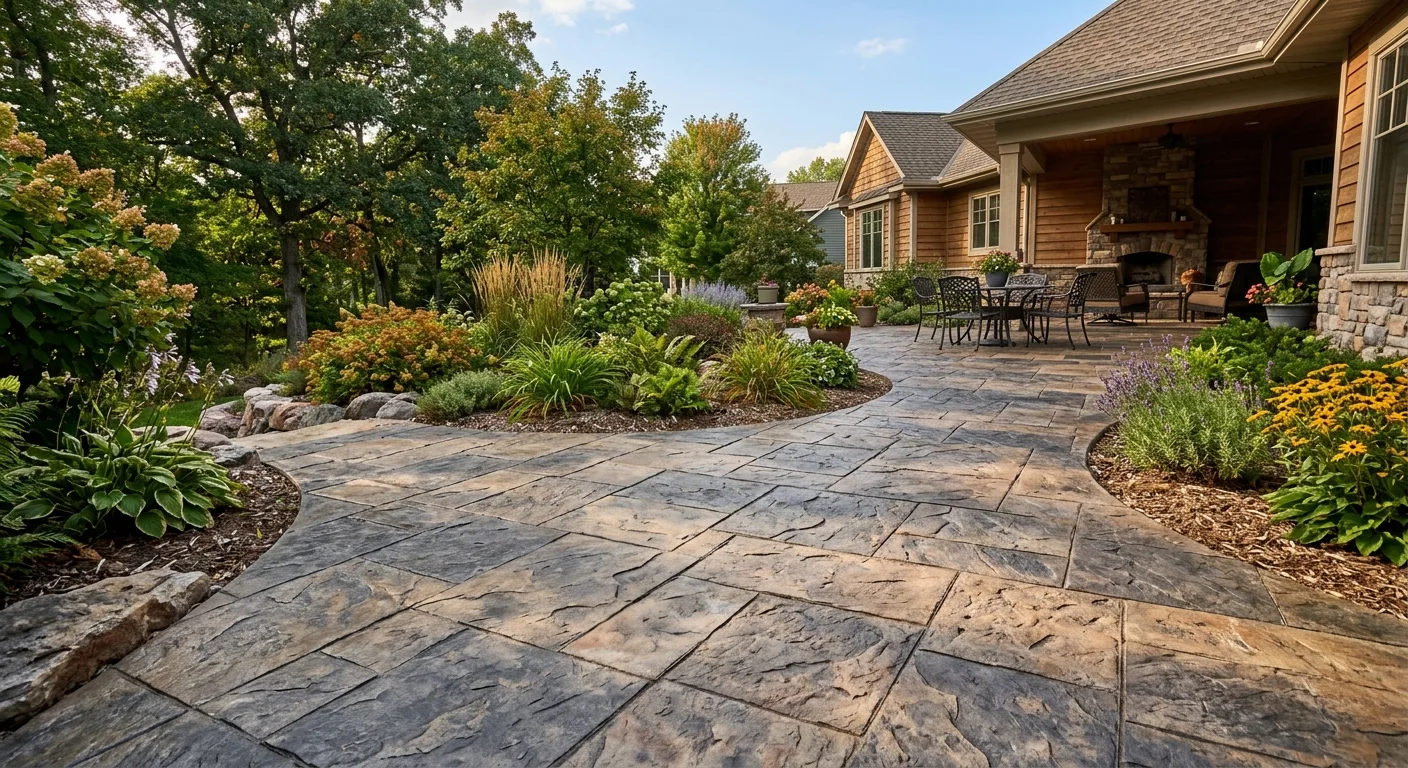
The most requested pattern in the metro. Clean rectangular shapes with natural variation in the grout line depth. Works on patios, pool decks, and large walkways.
Cobblestone

Rounded, irregular shapes that give a European street feel. Works well as a border treatment around a larger flat field or as a standalone driveway pattern.

Wood Plank

Stamped to replicate deck boards or barn wood. Popular for covered patio areas where homeowners want the look of wood without the maintenance.

Random Stone

Mimics irregular flagstone or fieldstone. The random layout means no obvious repeat in the pattern, which reads as the most naturalistic of the common options.

Color Hardeners and Stains

Integral color goes into the mix. Color hardener goes on the surface at pour time. Acid stain or acetone stain gets added after. Layering two or three gives depth that flat color can't replicate.

Sealers

High-gloss sealers pop the color but can get slick when wet. Matte or satin finishes are safer underfoot and still protect the surface from freeze-thaw and UV damage.

Reviews

What Our Customers Say

Rated 4.8/5 from 66 Google reviews

“Nova Concrete did our backyard patio in a flagstone stamp pattern. Looks better than I expected and the crew was straightforward about what was possible on our budget. No surprises on the final bill.”

Homeowner, Twin Cities Metro Verified Google review

“We got three bids on a stamped driveway. Nova came in with the most detail about how they'd prep the base. That was the thing that sold us. Work held up through the first full Minnesota winter without a crack.”

Verified Google Review Verified Google review

“The color match on the border was exactly what we drew out on paper. Olidia walked us through the whole process before they started. We knew what to expect at every stage.”

Verified Google Review Verified Google review

Free estimate

Get a Stamped Concrete Estimate

Nova Concrete handles residential and commercial stamped concrete projects across the Twin Cities metro. Fully insured. 1-year warranty on completed work. Call (612) 462-2610 or visit the quote page to get started.

Or send us your info

FAQ

Frequently Asked Questions

What is decorative stamped concrete? +
Decorative stamped concrete is poured concrete that gets textured with rubber or polyurethane stamp mats before it fully cures. Color hardeners and stains are added during and after the pour to create the appearance of natural stone, brick, slate, or wood. The finished surface is a single solid slab rather than individual pavers or cut stone, which eliminates joints where weeds can grow and pavers can shift over time.
What is the downside of stamped concrete? +
The two honest downsides are resealing and cracking. Stamped concrete needs a fresh sealer coat every two to three years or the color fades and the surface becomes more vulnerable to freeze-thaw damage. Cracking is also possible, especially if the subbase wasn't prepared correctly or control joints weren't placed at the right intervals. A well-installed slab on a solid base with proper jointing holds up well, but it's not zero-maintenance.
How much does decorative concrete overlay cost? +
A decorative concrete overlay applied over existing concrete typically costs less than a full stamped pour, but it's a different product with different limitations. Overlays are thin coatings, usually 1/4 inch or less. They won't fix a structurally compromised slab underneath. Full stamped concrete installations in the Twin Cities metro range from roughly $2,000 to $15,000 or more depending on square footage, pattern complexity, and site conditions. Every job is different — contact Nova Concrete for an accurate estimate.
What are the common problems with decorative concrete? +
Fading color is the most common complaint, almost always caused by sealer that wore off and wasn't reapplied. Surface delamination happens when color hardener was applied incorrectly or the sealer was put on before the concrete fully cured. Cracking along stress lines is a base prep issue. Efflorescence, the white powdery residue, comes from water moving through the slab and depositing minerals on the surface. Most of these problems are preventable at the installation stage.
How long does stamped concrete last in Minnesota's climate? +
A properly installed stamped slab in Minnesota should last 25 years or more. The freeze-thaw cycle is the main stress factor here. Concrete that's sealed well and kept clear of standing water handles it. Concrete with poor drainage, inadequate base depth, or sealer that's been neglected for years tends to show surface spalling within a decade. We design base depth and joint placement around Minnesota's frost conditions, not a generic national standard.
Can stamped concrete be repaired if it cracks or chips? +
Minor cracks can be filled and resealed with a reasonable color match. Major cracks that run through the full slab depth usually mean a section replacement, not a patch. Color matching on repairs is never perfect because the existing slab has weathered. We're honest about what a repair will look like before we do it. If a section needs to come out and be repoured, that's a more involved job but it's doable. We also handle garage slabs and basement slabs if the damage extends indoors.

Related