
Bloomington, MN
Stamped Concrete Cost in Minnesota: What Actually Drives the Price
- Licensed & Insured
- Free In-Home Estimates
- Serving the Twin Cities metro
Request a Callback
Request a Callback
We respond same day. Free estimates, seven days a week.
- Trusted
- By Local Homeowners
- Fast
- Response Time
- 4.8-Star
- Rated on Google
- 100%
- Licensed & Insured
Stamped concrete cost in Minnesota is the number every Twin Cities homeowner wants pinned down before they call anyone, and almost every online price guide gets it wrong by leaving out the two things that actually move the price here: our freeze-thaw climate and the expansive clay under most south metro yards. We are not going to hand you a per-square-foot figure in this post, because a real number depends on your grade, your soil, and the pattern you want, and any contractor who quotes stamped work sight-unseen is guessing. What we will do is walk you through the actual cost drivers so you can read a quote and know what you are paying for. After 12 years pouring decorative concrete across Bloomington, Edina, and the surrounding suburbs, owner Olidia Nova has our crew price stamped work to the job, not off a flat rate, because in this soil the sub-base is half the cost and none of the sales pitch. Nova Concrete is fully insured and backs every pour with a 1-year warranty.
The short version: the stamp pattern and color you pick are the part of stamped concrete cost you can see, but the freeze-thaw-rated mix and the sub-base prep over Minnesota clay are the part that decides whether your patio is still flat in year ten. Square footage, edge and border complexity, and how many colors you layer all push the number. The reseal every couple of years is a cost too, just a small recurring one. Skip the base and you pay twice.
What affects stamped concrete cost in Minnesota
Here is the direct answer. Stamped concrete cost in Minnesota is driven by five things, roughly in order of how much they move the number: the sub-base prep your soil demands, the concrete mix spec required to survive freeze-thaw, the total square footage, the pattern and color complexity, and the sealing cadence over the life of the slab. Most price guides only talk about the last two because they are the visible, fun part of the decision. The first two are where a Minnesota job genuinely diverges from a job in a mild climate, and they are why a quote here reads higher than a per-foot number you found on a national site. We would rather you understand the whole picture than get sticker shock at a quote that is actually priced correctly for our ground.
South metro clay note: much of Bloomington, Burnsville, and the surrounding suburbs sits on expansive clay that holds meltwater against a slab for weeks after snowmelt, and frost depth here can reach 60 inches. That is why we compact and grade the pad to pitch water away from the foundation before a single stamp goes down. The base work you cannot see is what keeps the patio you can see from heaving.
- Sub-base prep: over expansive clay, a proper compacted aggregate base and drainage grade cost more than a thin base on stable ground, and they are non-negotiable here.
- Freeze-thaw mix spec: a slab that rides 30 to 40 freeze-thaw swings a winter needs a higher-strength, air-entrained mix (we spec 4,000+ PSI) rather than a minimum residential pour.
- Square footage: more area is more concrete, more forming, and more finishing time, though larger pours can bring the per-foot number down.
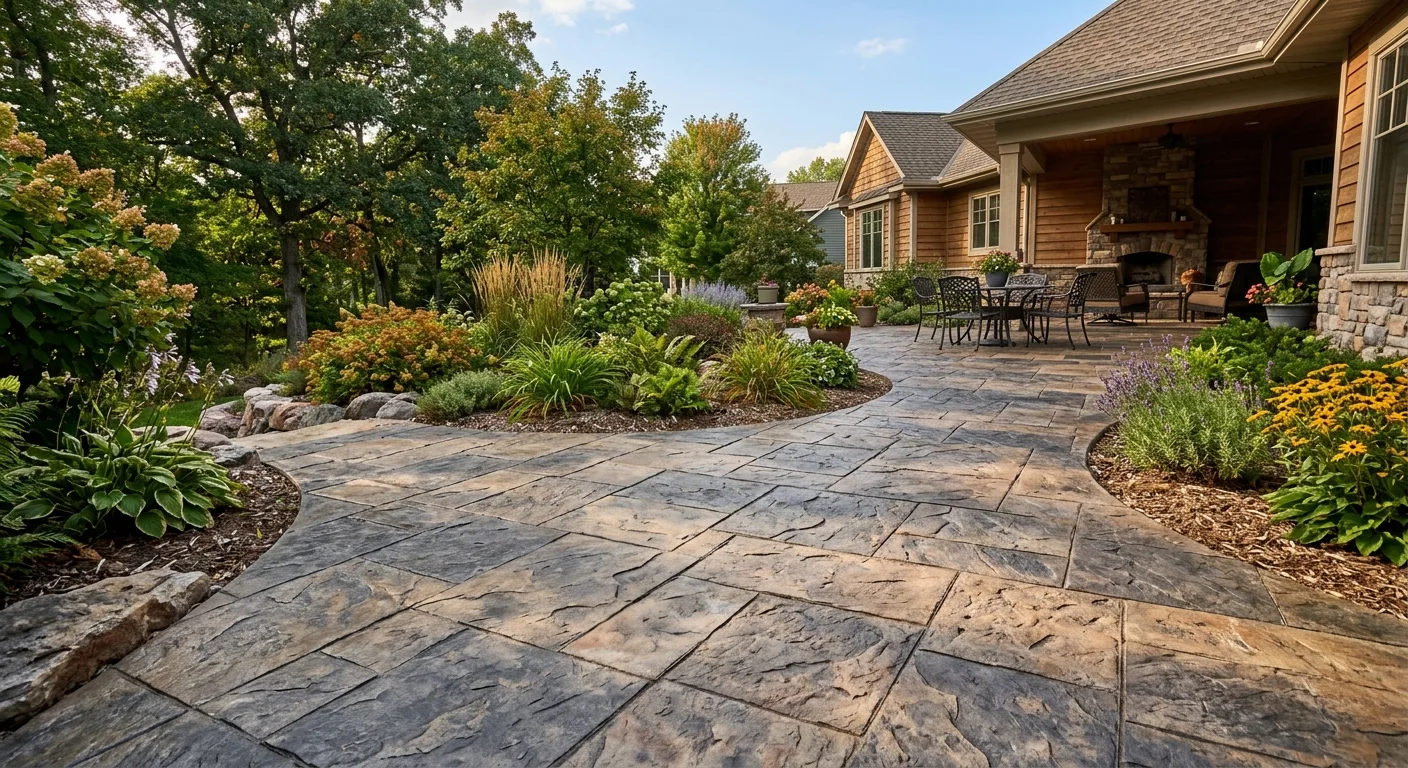
- Pattern and color complexity: a single running-bond pattern in one color prices differently than a multi-color, bordered slate or cobblestone layout with hand-detailed edges.
- Sealing cadence: stamped concrete needs resealing every two to three years in Minnesota to hold color and resist salt pitting, a small recurring cost worth budgeting for.
"People ask why our stamped quote is not the number they saw on a national price site. The answer is the base. On this clay, the sub-base is half the job. Cheap out on it and you are patching a cracked pattern by the second spring."
Why freeze-thaw and clay are the cost drivers price guides ignore
The honest reason a Minnesota stamped patio costs what it does is that it has to survive a climate a national price guide never accounts for. Down here a slab goes through 30 to 40 freeze-thaw swings between November and April, and water that gets into an unsealed surface or a thin crack in November acts like a pry bar by March as it freezes and expands. That is why we do not pour stamped concrete on a minimum-spec mix. We use a freeze-thaw-rated, air-entrained mix at 4,000 PSI or higher, because the tiny air voids in an air-entrained mix give freezing water somewhere to go instead of spalling the surface. That mix costs more than a bargain pour, and it is the reason a stamped slab we build lasts decades instead of pitting in a few winters.
How we price it, in one line: the stamp is the finish, the base and the mix are the job. We scope the grade, the drainage, and the soil first, because that is what decides whether a stamped patio in the Twin Cities holds up, and it is the honest half of the cost most guides leave out.
The clay is the other half of the story. Expansive clay swells when it takes on meltwater and shrinks when it dries, and that movement is what heaves a slab out of plane if the base under it was not built to handle it. A stamped slab is rigid, so unlike a paver system it cannot flex with the ground. Our answer is the sub-base: a compacted aggregate base, proper reinforcement, and a grade that pitches water away from the house and off the slab. That prep is real labor and real material, and it is the single biggest reason a correctly priced Minnesota quote reads higher than a warm-climate number. It is also the reason our slabs do not come back to us cracked. See how the decorative options come together on our stamped concrete patios and driveways and decorative stamped finishes pages.
Stamped concrete vs pavers cost
Stamped concrete is usually less expensive to install than hand-laid pavers, and the reason is labor. A stamped patio is poured and finished in one pass, while every paver is individually set on a prepared base, so the paver labor line runs higher. What you give up for that savings is repairability: a paver section can be lifted and reset, while a crack in a stamped slab is patched or the panel is replaced. Over the life of the surface the math evens out in a different way. Pavers cost you recurring maintenance, joints need re-sanding and sections need re-leveling every few years, while stamped concrete costs you a reseal every two to three years and little else. Neither is simply cheaper. They spread the cost differently across install and upkeep, which is exactly the trade-off we lay out before you commit. If you want the full surface-by-surface breakdown, our companion guide on stamped concrete vs pavers for a Minnesota patio walks through freeze-thaw behavior, upkeep, and longevity side by side.
| Cost factor | Stamped concrete | Pavers |
|---|---|---|
| Install labor | Lower, poured in one pass | Higher, every unit hand-set |
| Sub-base prep (MN clay) | Critical, rigid slab needs a strong base | Critical, but system flexes with heave |
| Recurring upkeep | Reseal every 2 to 3 yrs | Re-sand joints, re-level every 3 to 5 yrs |
| Repair | Patch or replace a panel | Lift and reset a section |
| Design range | Wide, one seamless patterned surface | Wide, modular units and colors |
Where your money goes on a stamped concrete patio
When you read a stamped concrete quote, it helps to know which line items are fixed by our climate and which are choices you control. The site prep, the freeze-thaw mix, and the reinforcement are largely set by your soil and by Minnesota code, they are the cost of building something that lasts here. The pattern, the number of colors, the border detail, and the total square footage are the levers you actually control, and they are where a homeowner can dial the number up or down. A simpler single-color pattern on a well-drained lot is the value end. A multi-color, bordered slate layout on a yard that needs regrading and extra base work sits higher, and that is not a markup, it is real work. Explore how these choices play out on our concrete patio installation page.
Frequently asked questions
Does stamped concrete crack in Minnesota winters?
It can, but a properly built one rarely does. Stamped concrete cracks in our climate for one of two reasons: the sub-base was too thin for the expansive clay and the slab heaved, or the mix was not freeze-thaw rated and salt and water pitted the surface. We build against both. On this soil we pour on a compacted aggregate base with proper reinforcement and grade the pad to drain, and we use an air-entrained mix at 4,000 PSI or higher that gives freezing water somewhere to go. Built that way, a stamped slab in the Twin Cities holds up for decades. The crack you hear about almost always traces back to a base someone cheaped out on.
How much does a stamped concrete patio add to home value?
A well-built stamped patio adds usable outdoor living space and curb appeal, which are the two things that move a buyer, so it generally helps resale, though we will not quote you a percentage because that depends on your home, your market, and how the patio fits the yard. What we can tell you is what protects the value: a slab built on a proper base with a freeze-thaw-rated mix stays flat and keeps its color, while a bargain pour that cracks or pits by the third winter becomes a liability a buyer notices. If value is the goal, the base and the mix matter more than the fanciest pattern.
Is stamped concrete cheaper than pavers?
Usually yes, on install. A stamped slab is poured and finished in one pass, while pavers are hand-set unit by unit, so the paver labor cost runs higher. You pay for that savings by giving up the lift-and-reset repairability of pavers, a crack in a stamped slab is patched rather than swapped. Over time the upkeep costs differ too: stamped concrete needs a reseal every two to three years, while pavers need joint re-sanding and re-leveling. Neither is simply cheaper, they spread the cost differently across install and maintenance.
Why is a Minnesota stamped concrete quote higher than online price guides?
Because national price guides do not price the sub-base prep and the freeze-thaw mix that a Minnesota job requires. On expansive clay with a 60-inch frost depth, the compacted base, the reinforcement, the drainage grade, and the air-entrained 4,000 PSI mix are the cost of building something that survives here, and they are exactly the line items a warm-climate per-foot number leaves out. A correctly priced quote here reflects the ground it is being poured on. That is not a markup, it is the half of the job that keeps your patio from heaving.
Want a real number for your yard?
We will scope your grade, drainage, and soil, walk you through pattern and color options, and give you a straight quote priced to the job, not a flat-rate guess. Fully insured, 1-year warranty, free estimates seven days a week.
What Customers Say
What Twin Cities Homeowners Say
"I had a great experience with NOVA. I got a quote, I ended up adding to it the day of…and they accommodated my request. They are fast, clean and do excellent work. I’m very pleased with the product and will be using them again for the next project. Highly recommend."
Amos J Olivarez
Verified Google review
"Had the team from Nova come and completely redo my front steps and patch up cracks in my foundation. They did an amazing job and the work was done quickly and went very smooth. Plus they are just good people! Highly recommend!"
Colin Owens
Verified Google review
"I had a really great experience with Nova Concrete LLC. They worked on my driveway and patio, and everything turned out exactly how I hoped. The crew was easy to work with, showed up on time, and clearly knew what they were doing. They paid attention to the little details, and it really shows in…"
Ashley Trevino
Verified Google review
Free estimate
Ready to start your concrete project?
Call Nova Concrete for a free, no-obligation estimate. Quality work, seven days a week.
Or send us your info